Car Designs and Innovations
Car design is at the heart of Formula 1’s technology, performance, and safety. Every fraction of a second gained on track comes from advances in aerodynamics, chassis engineering, and changing technical regulations. This page looks at how airflow, chassis strength, and key design changes have shaped modern F1 cars.
Aerodynamics
Aerodynamics is the study of how air flows around the car and how that airflow affects speed, stability, and grip. In F1, the goal is to create as much downforce as possible, which presses the car into the track, while keeping drag low so the car stays fast on the straights.
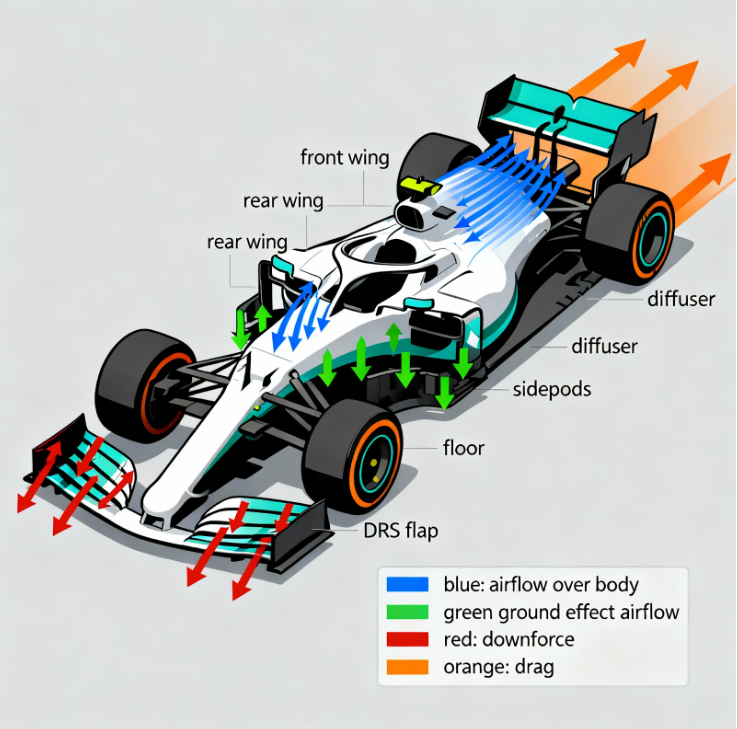
Front and rear wings generate downforce and balance, while devices like the Drag Reduction System (DRS) can reduce drag for overtaking. Under the car, the floor and diffuser speed up airflow to create ground effect, sucking the car toward the track and boosting cornering grip.
Teams use computational fluid dynamics (CFD) and wind tunnels to test thousands of shapes and find tiny aerodynamic gains that add up over a race distance.
Key Aerodynamic Parts
| Label | Explanation |
|---|---|
| Front Wing | The front wing creates pressure that pushes the front tires down to help the car turn better. It also guides airflow around the tires and under the car. |
| Rear Wing | The rear wing pushes down on the back of the car to keep it stable when cornering. It has a flap (called DRS) that can open to reduce air resistance and help the car go faster on straight parts. |
| Diffuser | Located under the back of the car, the diffuser pulls air out from under the car quickly, which pulls the car down onto the track to increase grip without slowing it down too much. |
| Sidepods | The sidepods help cool the car’s engine by directing air, and they also shape airflow to help the car stay balanced. |
| Floor / underbody | The bottom of the car is shaped to speed up air flowing under it, creating suction that pulls the car down for more grip (called ground effect). |
| DRS flap | A special part in the rear wing that opens on straight sections to make the car go faster by reducing drag (air resistance). |
| Downforce (red arrows) | The force that pushes the car down onto the track, helping the tires grip the road better so the car can corner faster and accelerate harder. |
| Drag (orange arrows) | Air pushing against the car and slowing it down. Designers try to reduce drag so the car can go faster on straight sections. |
| Ground effect (green arrows) | How air moves under the car to create low pressure and suck the car down, giving it extra grip without adding much drag. |
Chassis Design
The chassis is the structural backbone of the car, holding the driver, engine, and suspension together. It must be light, stiff, and strong enough to protect the driver in high‑speed crashes.
Early F1 cars used steel or aluminum frames, but teams switched to carbon‑fiber monocoques in the 1980s. A modern monocoque survival cell surrounds the driver and is paired with energy‑absorbing crash structures at the front, rear, and sides.
Safety devices like the Halo, added in 2018, protect the driver’s head from debris and impacts while keeping visibility good enough for racing.

Key Design Changes Over Time
.webp)
In the 1950s and 1960s, the introduction of the monocoque chassis improved safety and weight distribution compared to older space‑frame designs.
The 1970s saw the ground‑effect revolution, where sculpted underbodies and side skirts generated huge downforce and dramatically raised cornering speeds. Later decades brought turbocharged engines, active suspension, and eventually hybrid power units.
In the 2020s, rule changes simplified wings and bodywork to reduce turbulence and allow cars to follow each other more closely, while pushing sustainability through new fuel rules and powertrain tweaks.
Technological Innovations
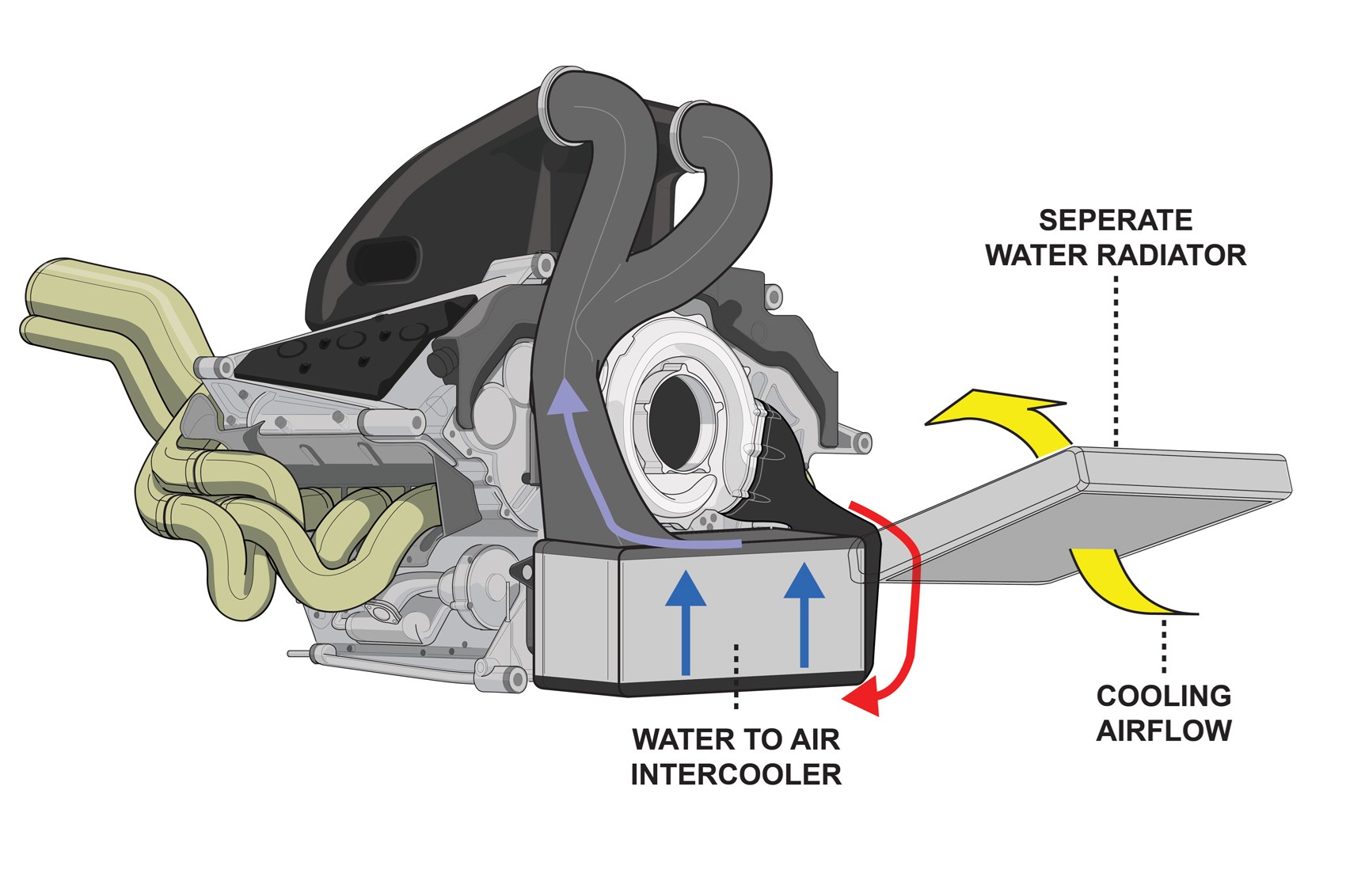
Modern F1 cars use hybrid powertrains that combine a turbocharged engine with energy‑recovery systems. These systems harvest energy from braking and exhaust gases and redeploy it to improve acceleration and efficiency.
Teams also rely on advanced materials, including complex carbon composites and 3D‑printed components, to reduce weight and create detailed shapes. Hundreds of sensors feed real‑time data back to engineers, who adjust setups and race strategy from the garage.
Looking ahead, electric drive technology, AI‑based performance analysis, and more sustainable materials are likely to influence how future F1 cars are built.
How Innovations Affect Racing

Improvements in aerodynamics and chassis design raise cornering speeds and reduce lap times, but they also change how drivers manage tires and fuel across a race. Ground‑effect eras, for example, have reshaped how cars behave in fast corners.
Devices like DRS created new overtaking opportunities on straights, while safety innovations such as the Halo have protected drivers during major accidents without slowing the sport down.